Restringing Notes
Difficult Bass Splice
Created Sunday 17 March 2024
After yesterday's workshop, I was sorry that those who attempted a splice in the low bass of the Steiff were unsuccessful. I was distracted enough with other things that I didn't get involved to help build success.
This morning I went out to the shop to try the most difficult myself. I purposely broke C#1 and attempted the repair. Unfortunately I failed. I formed a bad loop on the stiff, brittle wire in the piano. I cut it off and with even less room I made a good loop. Unfortunately I could not slip my lead wire through that loop, because the bend was too tight. So, customer ... we'll have to order a new bass string.
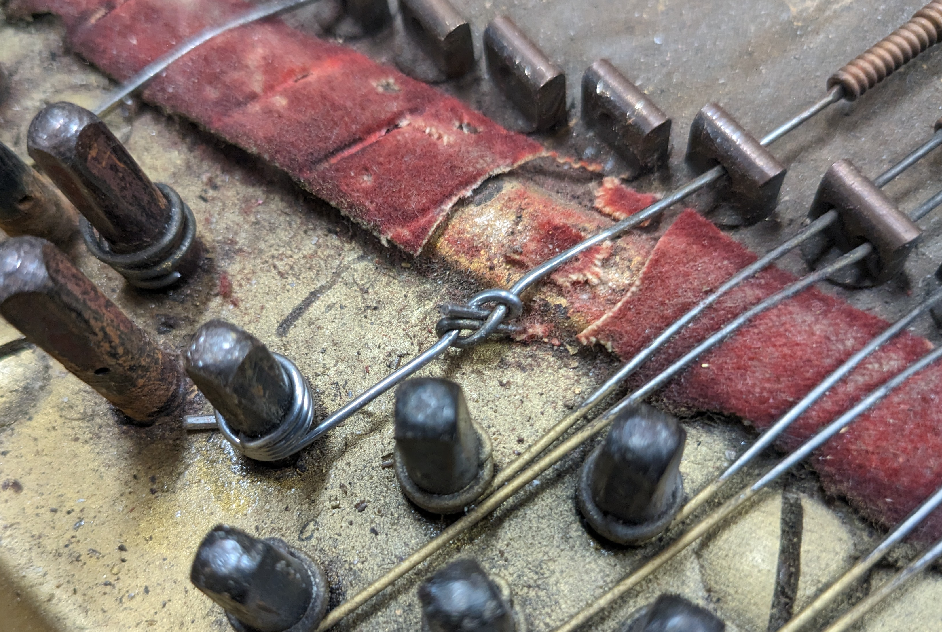
I made a second repair on F#1. The success indicators were greater. The pin was set further from the agraffe, and the core wire was smaller. The core wire was 0.047", #21. The C#1 wire that failed had a more challenging core dimension of 0.055 inches, #25.
The photo below is my success with F#1. Obviously the understring cloth took a beating, but the splice is classically good. The key to success when having little room is to make the bends as small as possible. That is most easily done on the lead outside of the piano for two reasons:
- Outside of the piano you have room for your hands as you form the loop.
- The new wire will be more ductile than the old wire
If you wish to practice making these difficult splices, I recommend that you begin by making very tight bends on lead wires outside of the piano. Aft er that is mastered, you are ready to try the more difficult bend inside the piano. You can simulate that on a stringing jig, but it won't have 110 year old wire like the Stieff does. If you wish, you may come back for more practice while the piano is still set up in the shop.
Here is a video where I form a very tight loop in number 25 wire: VIDEO
When watching the video, you may note that I used the strongest clamping pressure that the vise grips could provide.